By Karmina Conde
If you’re bilingual and a book lover like me, you know there’s a certain beauty in reading a book in two languages.
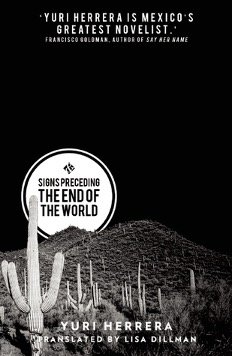
Signs Preceding the End of the World (Señales que precederán al fin del mundo) is a novel by Mexican writer Yuri Herrera. Using a play of language and Greek tragedy, it follows the journey of Makina, a young woman crossing the border to find her brother. Despite the story being short and less than 100 pages, Herrera’s writing says enough and impacts the reader in many ways.
Each chapter is designed to represent one of the nine stages of the Aztec underworld, developing Makina’s journey of finding her brother. In Aztec mythology, souls go on a journey full of challenges that lead the way to a final resting place, Mictlán. The journey involves crossing a river aided by a dog, which Makina does with Chuco, a slang word that means dog or mutt.
Everything in Herrera’s piece carries detail and a meaning, which I often related to many Greek stories like The Odyssey or even the roman text Dante’s Inferno.
The story is set to be timeless; the readers never know if Makina has phone service, a watch or if it’s been weeks or just days of her journey. This ambiguity makes the border feel less like a specific geopolitical place but more like a mythic threshold, suspended out of ordinary time. In a sense, the end of the world seems timeless.
Herrera’s details explain the challenges and risks that people face when crossing the border. Yet he doesn’t turn the novel into a documentary. Instead, he elevates migration into allegory, suggesting that displacement is not just physical but linguistic and existential. Makina is constantly translating between people, regions and ultimately, identities.
I first read this novel in Spanish back in 2022, but recently read it again in English under Lisa Dillman’s translation. In 2026, Dillman and Herrera won the Best Translated Book Award for Fiction.
Reading the translator’s note makes you understand not only the difficult process of having to translate a book, but also the way we as readers also interpret Herrera’s words. As someone who read in Spanish, there were many things I didn’t realize that were there until I read it again in English.
This could be due to the way language carries cultural weight beyond literal definitions. Herrera uses regional slang and also invents words in his novel, so how could a translator possibly work with that to make the English reader understand?
Dillman’s translation is not simply conversion. She understood Herrera’s rhythm, details and symbolic architecture. Without that understanding, meaning would be flattened. With it, meaning multiplies.




 -
- -
- -
- -
- -
-