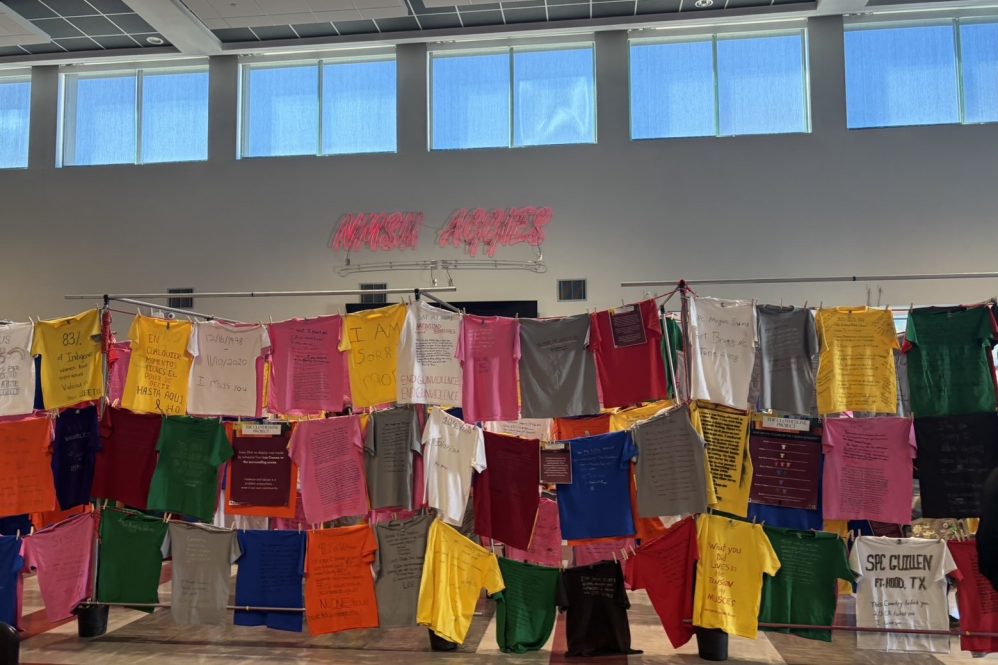
LAS CRUCES, N.M. — Colorful T-shirts swayed gently in the afternoon breeze across the New Mexico State University campus with each one carrying words, art and memories that spoke louder than any lecture could.
The Clothesline Project, hosted by the NMSU Department of Criminal Justice, returned this week as a powerful visual display of resilience, courage and community healing.
Originating in Cape Cod, Mass., in 1990, the Clothesline Project began as a grassroots movement to raise awareness about violence against women. Over the decades, it has evolved into a national and global initiative. It honors all survivors of violence as well as domestic and sexual abuse. It also remembers those who have lost their lives to it. Each shirt represents an individual’s personal story, a symbolic voice for those who have endured what too often remains unspoken.
At NMSU, the project transforms the campus into a place of reflection and solidarity. Rows of shirts in various colors hang along clotheslines, with each color representing a different type of violence or relationship to the victim from survivors of assault to families who have lost loved ones. Students, faculty and staff stop by to read the handwritten messages, often pausing in silence or shedding quiet tears.
For many, it is a heavy experience, one that reminds them of the painful realities that exist beyond the classroom. Yet, within the pain, there is also hope.
NMSU student Melanie Alvarado shared her thoughts after walking through the display.
“I think that a lot of things that happen in a person’s life, our brain is just hardwired to focus on the negatives instead of the positives,” Alvardo said. “Start with little things, just make it slightly better. Take baby steps and you will make it to the end of the rainbow. Take it easy. You will start to see the beautiful things.”
Her words reflect the essence of what the Clothesline Project stands for, which are small steps toward healing, one story and one voice at a time.
Another student, Sydney Huber, has witnessed the project’s impact throughout her years at the university.
“I have been seeing these shirts since my freshman year of college, and it’s just heartbreaking but powerful to see how many people are willing to talk about what they have been through,” Huber said. “I think it is important for these events to happen, so we can talk about it and so they can share their story. Having a community helps the healing process and the wounds.”
Huber’s reflection highlights one of the most important elements of the project, which is connection. By sharing their experiences publicly, survivors not only reclaim their voices but also create a sense of community that helps others feel less alone.
Throughout the day, dozens of students stopped to add shirts of their own or simply stand among the colorful rows in quiet respect. Faculty members and student organizations joined in support, emphasizing awareness and compassion being crucial in combating violence and promoting healing.
Victims, and those concerned about the threat of domestic violence can call the national hotline at 800-799-7233. In the Las Cruces area, La Casa Inc. provides counseling and shelter for victims of domestic violence. La Casa can be reached at 575-526-2819.
What makes the Clothesline Project so impactful is its simplicity. There are no fancy displays or digital screens. It is just shirts, stories and raw emotion. Yet, this simplicity is what gives it power. Each shirt becomes a visual testament to survival and strength, a reminder that even in moments of despair, there is hope, love and resilience.
For NMSU, events like the Clothesline Project are more than annual displays. They are calls to action and remind the community that healing requires both honesty and empathy. It is about listening, supporting and standing up for those who cannot always stand on their own.



 -
- -
- -
- -
- -
-